Download Class 12 Complete NCERT Books PDF in English and Hindi Mediums.Get the latest, updated NCERT textbooks for all subjects – fully aligned with the CBSE curriculum. No login required. One-click download. Free access for students and teachers.
Download Class 12 NCERT Textbooks Subject-wise
Click on the links below and jump to your subject.
- Download Class 12 – Physics (Hindi & English Medium)
- Download Class 12 – Chemistry (Hindi & English Medium)
- Download Class 12 – Biology (Hindi & English Medium)
- Download Class 12 – Mathematics (Hindi & English Medium)
- Download Class 12 – English
- Download Class 12 – Hindi
- Download Class 12 – Sanskrit
- Download Class 12 – Informatics Practices
- Download Class 12 – Biotechnology
- Download Class 12 – Computer Science
- Download Class 12 – Economics (Hindi & English Medium)
- Download Class 12 – Accountancy (Hindi & English Medium)
- Download Class 12 – Business Studies (Hindi & English Medium)
- Download Class 12 – History (Hindi & English Medium)
- Download Class 12 – Political Science (Hindi & English Medium)
- Download Class 12 – Geography(Hindi & English Medium)
- Download Class 12 – Psychology (Hindi & English Medium)
- Download Class 12 – Sociology (Hindi & English Medium)
- Download Class 12 – Human Ecology and Family Sciences (Hindi & English Medium) / Home Science
- Download Class 12 – Sangeet(Hindi & English Medium)
- Download Class 12 – Fine Art(Hindi & English Medium)
- Download Class 12 – Urdu
- Download Class 12 – Creative Writing
कक्षा 12 की सभी एनसीईआरटी पुस्तकें पीडीएफ में मुफ्त डाउनलोड करें। यहां आपको CBSE बोर्ड के लिए आवश्यक नवीनतम एनसीईआरटी पुस्तकें मिलेंगी – हिंदी और अंग्रेज़ी माध्यम दोनों में।
About Class 12 NCERT Books
The National Council of Educational Research and Training (NCERT) publishes textbooks under the National Education Policy (NEP) 2020. These books are the official curriculum for the Central Board of Secondary Education (CBSE) and several NCERT-aligned state boards.
Class 12 is the Senior Secondary level, where students choose subjects based on their academic stream. This subject specialization is crucial for board examination preparation and future academic or career paths.
The major streams and their key subjects include the following given below.

🎓 Science (Medical & Non‑Medical) – 12th Class

💼 Commerce – 12th Class
- Accountancy
- Business Studies
- Economics
- Mathematics (optional)
- English and Hindi (compulsory languages)

✍️ Humanities / Arts – 12th Class
- Home Science
- Fine Arts
- Philosophy
- Music, Physical Education (among other electives)

🧰 Vocational & Skill Subjects – 12th Class
- Engineering Drawing
- Tourism & Hospitality
- Fashion Design
- Computer Applications
- Life Skills and more
These NCERT Class 12 textbooks are essential for building concept clarity, acing board exams, and preparing for competitive exams like NEET, JEE, CUET, and various professional entrance tests. We also provide books in various formats — PDFs, chapter-wise downloads, and subject-wise collections — tailored toward each stream for greater study efficiency.
All books are sourced directly from the official NCERT website.
Physics – Class 12th – NCERT Textbook
The Class 12 NCERT Physics textbook is divided into two parts, covering advanced concepts that build upon Class 11 fundamentals. It focuses on both theoretical understanding and numerical problem-solving — essential for CBSE board exams, competitive tests like JEE/NEET, and applied sciences.
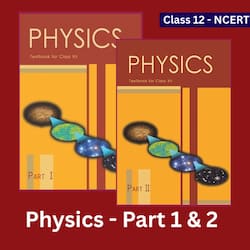
Physics – 12th Class – NCERT
Download Physics Part – 1
Download Physics Part – 2
Physics Part 1 Chapters:
- Electric Charges and Fields – Coulomb’s Law, electric field, flux.
- Electrostatic Potential and Capacitance – Potential energy, capacitors.
- Current Electricity – Ohm’s law, Kirchhoff’s rules, Wheatstone bridge.
- Moving Charges and Magnetism – Magnetic effects of current.
- Magnetism and Matter – Earth’s magnetism, hysteresis.
- Electromagnetic Induction – Faraday’s laws, Lenz’s law.
- Alternating Current – AC circuits, resonance, transformers.
- Electromagnetic Waves – Displacement current, spectrum.
Physics Part 2 Chapters:
- Ray Optics and Optical Instruments – Reflection, refraction, lens formulas.
- Wave Optics – Interference, diffraction, polarization.
- Dual Nature of Radiation and Matter – Photoelectric effect, de Broglie waves.
- Atoms – Bohr’s model, hydrogen spectrum.
- Nuclei – Radioactivity, nuclear energy.
- Semiconductors – Diodes, transistors, logic gates.
- Communication Systems – Modulation, bandwidth, propagation.
Chemistry – Class 12th – NCERT Textbook
The Class 12 Chemistry NCERT book is part of the PCM (Physics, Chemistry, Mathematics) combination central to the CBSE (Central Board of Secondary Education) board exams. It delivers a deep dive into physical, inorganic, and organic chemistry—covering both theoretical foundations and practical applications. In today’s competitive exam landscape, mastering it is essential for engineering entrance tests like JEE‑Main, JEE‑Advanced, BITSAT and IISER‑IAT, as well as the NEET‑UG medical entrance.
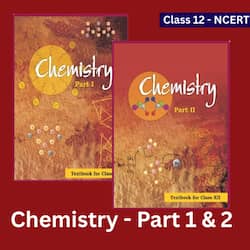
Chemistry – 12th Class – NCERT
Download Chemistry Part – 1
Download Chemistry Part – 2
Part I: Physical & Inorganic Chemistry – Chapters
- Solid State – Crystal lattices, unit cells, defects.
- Solutions – Concentration, colligative properties, Raoult’s Law.
- Electrochemistry – Redox reactions, Nernst equation, batteries.
- Chemical Kinetics – Reaction rates, order, activation energy.
- Surface Chemistry – Adsorption, catalysts, emulsions.
- General Principles & Processes of Isolation of Elements – Metallurgy basics and refining techniques.
Part II: Organic Chemistry & Biomolecules – Chapters
- The p-Block Elements – Group 15 to 18 elements, their compounds.
- The d- and f-Block Elements – Transition and inner-transition elements.
- Coordination Compounds – Ligands, bonding, nomenclature, isomerism.
- Haloalkanes and Haloarenes – Nucleophilic substitution, mechanisms.
- Alcohols, Phenols, and Ethers – Properties, reactions, uses.
- Aldehydes, Ketones and Carboxylic Acids – Structure, reactivity.
- Amines – Classification, basicity, reactions.
- Biomolecules – Carbohydrates, proteins, vitamins, enzymes.
- Polymers – Types, classification, commercial uses.
- Chemistry in Everyday Life – Drugs, cleansing agents, food additives.
Biology – Class 12th – NCERT Textbook
The Class 12 Biology NCERT book is part of the PCB (Physics, Chemistry, Biology) combination essential for students preparing for CBSE (Central Board of Secondary Education) board exams. It provides a comprehensive exploration of human physiology, genetics, biotechnology, ecology, and evolution—blending scientific concepts with real-world biological applications. In the current academic landscape, it is a must-study resource for medical entrance exams like NEET‑UG, AIIMS (now part of NEET), and other life sciences-based undergraduate entrance tests including CUET for BSc programs.
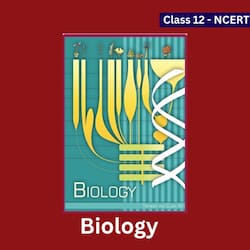
Biology- 12th Class – NCERT
Download Biology Part – 1
Class 12 NCERT Biology Textbook – Chapters
- Unit VI – Reproduction
- Reproduction in Organisms
- Sexual Reproduction in Flowering Plants
- Human Reproduction
- Reproductive Health
- Unit VII – Genetics and Evolution
- Principles of Inheritance and Variation
- Molecular Basis of Inheritance
- Evolution
- Unit VIII – Biology in Human Welfare
- Human Health and Disease
- Strategies for Enhancement in Food Production
- Microbes in Human Welfare
- Unit IX – Biotechnology and Its Applications
- Biotechnology: Principles and Processes
- Biotechnology and Its Applications
- Unit X – Ecology and Environment
- Organisms and Populations
- Ecosystem
- Biodiversity and Conservation
- Environmental Issues
Mathematics – Class 12th – NCERT Textbook
The Class 12 Mathematics NCERT book is part of the PCM (Physics, Chemistry, Mathematics) combination central to the CBSE (Central Board of Secondary Education) board exams. It builds a strong foundation in algebra, calculus, geometry, and statistics—developing analytical and problem-solving skills essential for academic and competitive success. In today’s entrance exam ecosystem, it plays a critical role in undergraduate-level tests such as JEE‑Main, JEE‑Advanced, BITSAT, IISER‑IAT, as well as aptitude-based exams like BBA entrance tests, hotel management exams, and other quantitative assessments.
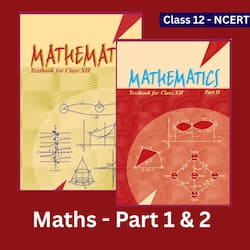
Mathematics – 12th Class – NCERT
Download Mathematics Part – 1
Download Mathematics Part – 2
Mathematics Class-12 Part-1: Chapters
- Relations and Functions
- Inverse Trigonometric Functions
- Matrices
- Determinants
- Continuity and Differentiability
- Application of Derivatives
Mathematics Class-12 Part-2: Chapters
- Integrals
- Application of Integrals
- Differential Equations
- Vector Algebra
- Three Dimensional Geometry
- Linear Programming
- Probability
English – Class 12th – NCERT Textbook
The Class 12 English Core syllabus under CBSE (Central Board of Secondary Education) includes three official NCERT books: Flamingo (main reader), Vistas (supplementary reader), and Kaleidoscope (a collection of short stories, poetry, drama, and non-fiction). English is one of the official languages of India, recognized under the Eighth Schedule of the Constitution of India. Strong command over English is not only essential for scoring well in board exams but also critical for competitive entrance tests like CUET, CLAT, BBA, hotel management exams, and interviews for various undergraduate programs.
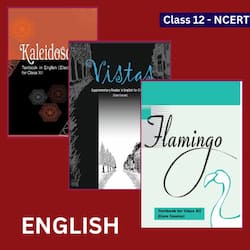
English – 12th Class – NCERT
English Flamingo (Main Reader) Chapters
- Prose
- The Last Lesson
- Lost Spring
- Deep Water
- The Rattrap
- Indigo
- Poets and Pancakes
- The Interview
- Going Places
- Poetry
- My Mother at Sixty-Six
- An Elementary School Classroom in a Slum
- Keeping Quiet
- A Thing of Beauty
- Aunt Jennifer’s Tigers
English Vistas (Supplementary Reader) Chapters
- The Third Level
- The Tiger King
- Journey to the End of the Earth
- The Enemy
- Should Wizard Hit Mommy?
- On the Face of It
- Evans Tries an O-Level
- Memories of Childhood
English Kaleidoscope (Elective English) Chapters
- Short Stories
- I Sell My Dreams – Gabriel Garcia Marquez
- Eveline – James Joyce
- A Wedding in Brownsville – Isaac Bashevis Singer
- Tomorrow – Joseph Conrad
- Poetry
- A Lecture Upon the Shadow – John Donne
- Poems by Milton, Emily Dickinson, and Sylvia Plath
- Kubla Khan – Samuel Taylor Coleridge
- The Wild Swans at Coole – W. B. Yeats
- Non-Fiction
- Freedom – George Bernard Shaw
- The Mark on the Wall – Virginia Woolf
- On Science Fiction – Isaac Asimov
- The Story – E. M. Forster
- Drama
- Chandalika – Rabindranath Tagore
- Broken Images – Girish Karnad
Computer Science – Class 12th – NCERT Textbook
The Class 12 NCERT Computer Science book (Code 083) is the latest, updated, and revised edition aligned with CBSE’s current curriculum. It begins with Exception Handling and systematically covers core programming concepts including file handling, data structures (stacks and queues), searching and sorting algorithms, databases with SQL, computer networks, and cybersecurity. The content emphasizes practical application using Python and fosters computational thinking, logic building, and real-world tech readiness.
This revised edition is not just designed for board exam preparation but also lays a strong foundation for technical entrance exams such as JEE‑Main (for CSE/IT), CUET (for BSc Computer Science), and other coding, reasoning, or IT-oriented undergraduate programs.
Computer Science- 12th Class – NCERT
Class 12 – NCERT Computer Science (083)– Chapters (Updated)
- Exception Handling in Python – syntax errors, runtime exceptions, try‑except, raise, finally.
- File Handling in Python – text/binary files, CSV, pickle module
- Stack – list-based stack operations, prefix/infix/postfix evaluation
- Queue – list-based queue operations, dequeues
- Searching – linear and binary search algorithms
- Sorting – bubble, selection, insertion sorts; hash functions
- Understanding Data – basic statistics, visualization (mean, median, SD)
- Database Concepts – relational model, keys, relational algebra
- Structured Query Language (SQL) – DDL/DML, joins, constraints, MySQL integration
- Computer Networks – LAN/WAN topologies, devices, protocols
- Data Communication – transmission media, switching techniques, protocols
- Security Aspects – cyber threats, firewall, data protection, IPR
- Project-Based Learning – applying Python+DB skills in real-world mini-projects
Informatics Practices – Class 12th – NCERT Textbook
The Class 12 NCERT Informatics Practices textbook (Code 065) is the latest, updated, and revised edition aligned with CBSE’s 2025–26 academic curriculum. It introduces students to Python-based data handling, data visualization, SQL database operations, computer networking, and societal impacts of IT. The textbook balances conceptual clarity with practical application, enabling students to develop real-world tech and data literacy. It is highly relevant for CBSE board exams and supports entrance prep for BCA, BSc Computer Science, CUET, and data-driven fields like analytics and IT project management.
Informatics Practices Textbook- 12th Class – NCERT
Class 12 – NCERT Informatics Practices (2025-26 Edition): Chapters
- Querying and SQL Functions – SQL functions, GROUP BY, joins, operations on multiple relations.
- Data Handling Using Pandas – I – Series, DataFrames, importing/exporting CSV, Pandas vs NumPy.
- Data Handling Using Pandas – II – Descriptive stats, aggregation, sorting, handling missing values, MySQL integration.
- Plotting Data Using Matplotlib – Line plots, bar graphs, customization, Pandas plot functions.
- Internet and Web – Network types, devices, topologies, internet apps, website hosting, browsers.
- Societal Impacts – Digital footprints, cybercrime, IT Act, e-waste, privacy, health effects.
- Project-Based Learning – Real-world projects, teamwork, problem-solving with Python + MySQL.
Biotechnology – Class 12th – NCERT Textbook
The Class 12 Biotechnology NCERT textbook (Code 045), reprinted for 2025–26, is the latest updated edition, aligned with CBSE’s revised curriculum. This book focuses on the applied aspects of biotechnology, introducing advanced topics like recombinant DNA technology, genome engineering, bio-processing, stem cell and organ culture, bioremediation, and entrepreneurship in biotech. Designed to bridge theoretical knowledge with industrial and research applications, it equips students for CBSE board exams, biotech entrance tests, and careers in molecular biology, healthcare, pharma, and bio-entrepreneurship
Biotechnolgoy Textbook – 12th Class – NCERT
Class 12 NCERT Biotechnology (2025–26)- Chapters
- An Overview of Recombinant DNA Technology
- Host–Vector System
- Gene Cloning
- Applications of Recombinant DNA Technology
- Genome Technology and Engineering
- Microbial Culture
- Plant Tissue Culture
- Animal Cell Culture
- Stem Cell Culture and Organ Culture
- Bioprocessing and Biomanufacturing
- Bioremediation
- Recent Innovations in Biotechnology
- Entrepreneurship
Accountancy – Class 12th – NCERT Textbook
The Class 12 NCERT Accountancy syllabus is divided into two official textbooks: Accountancy Part I – Partnership Accounts (लेखाशास्त्र भाग 1 – साझेदारी खाते) and Accountancy Part II – Company Accounts and Analysis of Financial Statements (लेखाशास्त्र भाग 2 – कंपनी खाते और वित्तीय विवरणों का विश्लेषण). These books cover core areas in business accounting, including partnership firms, corporate accounts, and tools for financial analysis.
The subject develops practical financial literacy, analytical thinking, and documentation skills—crucial for students pursuing commerce, business administration, or finance. Mastery of these books is essential for the CBSE (Central Board of Secondary Education) board exams, and lays the foundation for professional studies like B.Com, CA (Chartered Accountancy), CMA, and CS. The books also align well with aptitude components of entrance exams such as CUET (Commerce), IPMAT, and other undergraduate business courses.
Accountancy Textbooks – 12th Class – NCERT
Download Accountancy Part – 1
Download Accountancy Part – 2
Class 12 – Accountancy Part I (Partnership Accounts)- Chapters
- Accounting for Partnership Firms: Basic Concepts
- Reconstitution – Admission of a Partner
- Reconstitution – Retirement/Death of a Partner
- Dissolution of a Partnership Firm (Chapter on Not-for-Profit Organisations has been removed)
Class 12 – Accountancy Part II (Company Accounts & Financial Analysis) – Chapters
- Accounting for Share Capital
- Issuing & Redemption of Debentures
- Financial Statements of a Company
- Analysis of Financial Statements
- Accounting Ratios
- Cash Flow Statement
Business Studies – Class 12th – NCERT Textbook
The Class 12 Business Studies curriculum under CBSE is structured into two official NCERT textbooks: Part I – Principles and Functions of Management (व्यवस्थापन के सिद्धांत एवं कार्य) and Part II – Business Finance and Marketing (वाणिज्यिक वित्त एवं विपणन). These books provide a comprehensive understanding of how businesses operate, make decisions, and serve consumers.
Part I focuses on management principles and their application in real business situations. It builds a foundational understanding of planning, organizing, staffing, directing, and controlling. Part II dives into the essentials of finance, marketing, and consumer protection—enabling students to understand how businesses fund operations, reach markets, and safeguard consumer interests.
These textbooks are essential for CBSE board exam preparation and highly relevant for students pursuing BBA, B.Com, MBA, or appearing for entrance exams like CUET (Commerce), IPMAT, and other undergraduate business programs.
Business Studies Textbooks- 12th Class – NCERT
Download Business Studies Part – 1
Download Business Studies Part – 2
Class 12 – Business Studies Part I – Principles and Functions of Management
- Nature and Significance of Management
- Principles of Management
- Business Environment
- Planning
- Organising
- Staffing
- Directing
- Controlling
Class 12 Business Studies Part II – Business Finance and Marketing
- Financial Management
- Financial Markets
- Marketing
- Consumer Protection
Economics – Class 12th – NCERT Textbook
The Class 12 Economics curriculum under CBSE (Central Board of Secondary Education) is structured into two NCERT textbooks, each available in Hindi and English:
- Introductory Microeconomics (आर्थिक सिद्धांत: सूक्ष्मअर्थशास्त्र)
- Introductory Macroeconomics (आर्थिक सिद्धांत: व्यापकअर्थशास्त्र)
These books collectively provide students with a well-rounded understanding of both individual economic behavior (micro) and national/global economic systems (macro).
- Microeconomics focuses on consumer behavior, production, pricing, and different market types.
- Macroeconomics addresses national income, money and banking, employment generation, public finance, and international trade.
This combination prepares students for the Central Board of Secondary Education (CBSE) board exams and forms the conceptual backbone for higher studies in Economics, Commerce, and Business Administration. The curriculum also supports entrance exams such as CUET (Economics), IPMAT, and undergraduate economic or finance-focused programs
Economics Textbooks – 12th Class – NCERT
Download Introduction to Microeconomics
Download Introduction to Macroeconomics
Class 12: Introductory Microeconomics (Part A): Chapters
- Introduction to Microeconomics
- Theory of Consumer Behaviour
- Production and Costs
- Theory of the Firm under Perfect Competition
- Market Equilibrium
- Non-Competitive Markets
Class 12: Introductory Macroeconomics (Part B): Chapters
- Introduction to Macroeconomics
- National Income and Related Aggregates
- Money and Banking
- Determination of Income and Employment
- Government Budget and the Economy
- Balance of Payments
Hindi – Class 12th – NCERT Textbook
The Class 12 Hindi Core syllabus under CBSE covers four NCERT textbooks, each published in English and Hindi:
- Antara (अंतरा) – selections in modern prose & poetry
- Aroh ( आरोह ) – complementary prose passages & poems
- Vitan ( वितान ) – additional literary pieces (mixed genres)
- Antral Part 2 ( अंतराल भाग २ ) – extended prose & poetry explorations
These texts cover Kavya (poetry), Gadya (prose), Vyakaran (grammar), and Rachnatmak Lekhan (creative writing)—ensuring balanced development of comprehension, expression, and linguistic accuracy. Mastery of these books is critical for Central Board of Secondary Education (CBSE) board exam success and greatly supports performance in Hindi language and literature sections of CUET, BBA, hotel management, and other entrance tests that feature Hindi.
Hindi Textbooks – 12th Class – NCERT
Download Hindi Textbooks
Class 12 – Hindi – NCERT – Aroh (आरोह) – Class 12 Hindi Core: Chapters
Kavya Khand (Poetry)
- कबीर
- तुलसीदास
- लक्ष्मीचंद
- जयशंकर प्रसाद
- सुमित्रानंदन पंत
- निराला
- नागार्जुन
- शमशेर बहादुर सिंह
- केदारनाथ अग्रवाल
- भवानी प्रसाद मिश्र
- सर्वेश्वर दयाल सक्सेना
- कुंवर नारायण
Gadya Khand (Prose)
- मृदुला गर्ग
- गोपाल चतुर्वेदी
- अज्ञेय
- भीष्म साहनी
- निर्मल वर्मा
- अमरकांत
- अरुण कमल
- शेखर जोशी
Class 12 – Hindi – Vitan (वितान): Chapters
- सिल्वर वैडिंग
- जूझ
- अतीत में दबे पाँव
- डायरी के पन्ने
Class 12 – Hindi – Antara (अंतरा): Chapters
- हरिवंश राय बच्चन
- आलोक धन्वा
- कुंवर नारायण
- रघुवीर सहाय
- गजानन माधव मुक्तिबोध
- शमशेर बहादुर सिंह
Class 12 – Hindi – Antral Part 2 (अंतराल भाग 2): Chapters
- गीत-अगीत
- अतीत में दबे पाँव
- नगे पांव
- आषाढ़ का एक दिन
- डायरी के पन्ने
Sociology – Class 12th – NCERT Textbook
The Class 12 Sociology curriculum under CBSE (Central Board of Secondary Education) comprises two official NCERT textbooks, available in both English and Hindi:
- Sociology English Titles:
- Indian Society
- Social Change and Development in India
- Sociology Hindi Titles:
- भारतीय समाज
- भारत में सामाजिक परिवर्तन एवं विकास
Indian Society explores the structure of Indian society—covering caste, tribes, family, kinship, market institutions, inequality, and cultural diversity.
Social Change and Development in India focuses on the dynamic aspects—how Indian society has transformed through industrialization, globalization, rural and urban change, democracy, and social movements. These books are vital for CBSE board exam preparation and lay the groundwork for undergraduate studies in Sociology, Social Work, and Humanities.
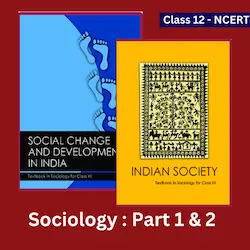
Sociology Textbooks – 12th Class – NCERT
Download Indian Society
Download Social Change & Development in India
Class 12 – Sociology – Part I – Indian Society: Chapters
- Introducing Indian Society
- The Demographic Structure of Indian Society
- Social Institutions: Continuity and Change
- The Market as a Social Institution
- Patterns of Social Inequality and Exclusion
- The Challenges of Cultural Diversity (Plus project work guidelines)
Class 12 – Sociology – Part II – Social Change and Development in India: Chapters
- Structural Change
- Cultural Change
- The Story of Indian Democracy
- Change and Development in Rural Society
- Change and Development in Industrial Society
- Globalisation and Social Change
- Mass Media and Communications
- Social Movements
Geography – Class 12th – NCERT Textbook
The Class 12 Geography curriculum under CBSE (Central Board of Secondary Education) is structured around three official NCERT textbooks, each available in both English and Hindi:
- Fundamentals of Human Geography (मानव भूगोल के मूल सिद्धांत)
- India: People and Economy (भारत: लोग और अर्थव्यवस्था)
- Practical Work in Geography (भूगोल में प्रयोगात्मक कार्य)
- Fundamentals of Human Geography introduces global themes like population, human activities, settlement systems, transport, and trade.
- India: People and Economy focuses on India’s demographics, resource management, economic development, and spatial planning.
- Practical Work in Geography develops data skills—covering data sources, field surveys, graphical representation, digital mapping, and spatial technologies.
Together, these books foster both theoretical understanding and real-world application. They are essential for CBSE board exam success and offer strong foundations for entrance exams like CUET (Geography), undergraduate programs in B.A. Geography, Environmental Studies, Urban Planning, and careers requiring spatial analysis.
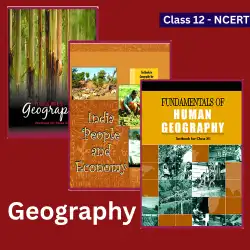
Geography Textbooks – 12th Class – NCERT
Download Geography NCERT in English Medium
Download Geography NCERT in Hindi Medium
Class 12 – Geography – Fundamentals of Human Geography : Chapters
- Nature and Scope of Human Geography
- World Population: Distribution, Density & Growth
- Population Composition
- Human Development
- Primary Activities
- Secondary Activities
- Tertiary & Quaternary Activities
- Transport & Communication
- International Trade
- Human Settlements
Class 12 – Geography – India: People and Economy : Chapters
- Population: Distribution, Density, Growth & Composition
- Migration: Types, Causes & Outcomes
- Human Development
- Human Settlements
- Land Resources & Agriculture
- Water Resources
- Mineral & Energy Resources
- Manufacturing Industries
- Planning & Sustainable Development
- Transport & Communication
- International Trade
- Geographical Perspective on Selected Issues
Class 12 – Geography – Practical Work in Geography : Chapters
- Data: Source & Compilation
- Data Processing
- Graphical Representation of Data
- Computer Use in Data Processing & Mapping
- Field Surveys
- Spatial Information Technology
History – Class 12th – NCERT Textbook
The Class 12 NCERT History curriculum under CBSE consists of three textbooks, each available in English and Hindi.
| History Class 12 – Book Title (English) | History Class 12 – Book Title (Hindi) |
|---|---|
| Themes in Indian History – Part I | भारतीय इतिहास के कुछ विषय – भाग 1 |
| Themes in Indian History – Part II | भारतीय इतिहास के कुछ विषय – भाग 2 |
| Themes in Indian History – Part III | भारतीय इतिहास के कुछ विषय – भाग 3 |
Part I covers early civilizations up to Harappan settlements, kinship, and culture changes.
Part II spans medieval India—Bhakti-Sufi movements, agrarian society, and major empires.
Part III focuses on colonialism, revolts, urbanisation, Gandhi’s role, Partition, and the making of the constitution.
These books develop analytical, narrative, and source-evaluation skills—crucial for CBSE board exams and for exams like CUET (History), and provide core readings for UPSC optional history.
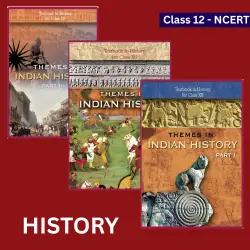
History Textbooks – 12th Class – NCERT
Download History NCERT in English Medium
Download History NCERT in Hindi Medium
Themes in Indian History – Part I Chapters:
- Bricks, Beads and Bones: The Harappan Civilisation
- Kings, Farmers and Towns: Early States and Economies
- Kinship, Caste and Class: Early Societies
- Thinkers, Beliefs and Buildings: Cultural Developments
Themes in Indian History – Part I Chapters:
- Through the Eyes of Travellers: Perceptions of Society
- Bhakti-Sufi Traditions: Religious Beliefs & Devotional Texts
- An Imperial Capital: Vijayanagara
- Peasants, Zamindars and the State
Themes in Indian History – Part I Chapters:
- Colonialism and the Countryside: Exploring Archives
- Rebels and the Raj: The Revolt of 1857 and Its Representations
- Colonial Cities: Urbanisation and Architecture
- Mahatma Gandhi and the Nationalist Movement
- Understanding Partition: Politics and Memories
- Framing the Constitution: The Beginning of a New Era
Political Science – Class 12th – NCERT Textbook
Class 12 CBSE Political Science is delivered via two official NCERT textbooks, available in both English and Hindi.
| Class 12 – Political Science: English Title | Class 12 – Political Science: Hindi Title |
|---|---|
| Contemporary World Politics | समकालीन विश्व राजनीति |
| Politics in India Since Independence | स्वतंत्र भारत में राजनीति |
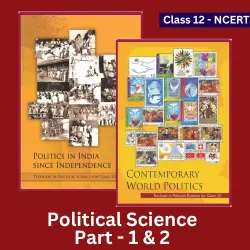
Political Science Textbooks – 12th Class – NCERT
Download Physics Part – 1
Download Physics Part – 2
Physics Part 1 Chapters:
- Electric Charges and Fields – Coulomb’s Law, electric field, flux.
- Electrostatic Potential and Capacitance – Potential energy, capacitors.
- Current Electricity – Ohm’s law, Kirchhoff’s rules, Wheatstone bridge.
- Moving Charges and Magnetism – Magnetic effects of current.
- Magnetism and Matter – Earth’s magnetism, hysteresis.
- Electromagnetic Induction – Faraday’s laws, Lenz’s law.
- Alternating Current – AC circuits, resonance, transformers.
- Electromagnetic Waves – Displacement current, spectrum.
Physics Part 2 Chapters:
- Ray Optics and Optical Instruments – Reflection, refraction, lens formulas.
- Wave Optics – Interference, diffraction, polarization.
- Dual Nature of Radiation and Matter – Photoelectric effect, de Broglie waves.
- Atoms – Bohr’s model, hydrogen spectrum.
- Nuclei – Radioactivity, nuclear energy.
- Semiconductors – Diodes, transistors, logic gates.
- Communication Systems – Modulation, bandwidth, propagation.
Psychology – Class 12th – NCERT Textbook
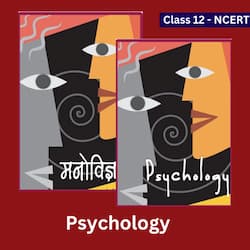
The Class 12 Psychology curriculum under CBSE is taught through a single NCERT textbook titled Psychology in English and मानसिक विज्ञान (Manovigyan) in Hindi. This book explores the scientific study of human behavior and mental processes, including personality, stress, social cognition, psychological disorders, and therapeutic interventions. It also emphasizes developing research skills, observation, and critical thinking, making it valuable for CBSE board exams, CUET (Psychology), and as a strong base for further psychology, counseling, and social sciences studies.
Psychology Textbooks – 12th Class – NCERT
Download Psychology Part – 1
| Chapter No. | Psychology – Class – 12 (English Medium) Chapters | Psychology – Class – 12 (Hidi Medium) Chapters |
|---|---|---|
| 1 | Variations in Psychological Attributes | मनोवैज्ञानिक गुणों में विविधता |
| 2 | Self and Personality | आत्म और व्यक्तित्व |
| 3 | Meeting Life Challenges | जीवन की चुनौतियों का सामना |
| 4 | Psychological Disorders | मनोवैज्ञानिक विकार |
| 5 | Therapeutic Approaches | उपचारात्मक दृष्टिकोण |
| 6 | Attitude and Social Cognition | अभिवृत्ति और सामाजिक संज्ञान |
| 7 | Social Influence and Group Processes | सामाजिक प्रभाव और समूह प्रक्रिया |
| 8 | Psychology and Life | मनोविज्ञान और जीवन |
| 9 | Developing Psychological Skills | मनोवैज्ञानिक कौशल का विकास |
Sanskrit- Class 12th – NCERT Textbook
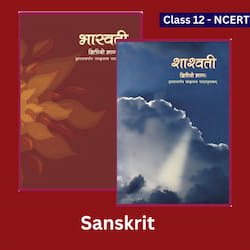
The Class 12 Sanskrit (Core) curriculum under CBSE is built around two NCERT textbooks, both in Sanskrit with explanatory content in Hindi:
- भास्वती (Bhaswati)
- शाश्वती (Shaswati)
भास्वती focuses on prose and verse selections from classical and modern Sanskrit literature, developing interpretive and grammatical skills.
शाश्वती extends into advanced literary themes, poetry, and philosophical excerpts to enrich language proficiency and analytical depth.
Together, these books build strong linguistic command in Sanskrit and prepare students for the CBSE board exams, Sanskrit scholarship tests, and higher Sanskrit studies in college.
Download Sanskrit Textbooks – 12th Class – NCERT
Class 12 – Sanskrit – Bhaswati (भास्वती) – 12 Chapter
- अनुशासनम्
- न त्वं शोचितुमर्हसि / मातुराज्ञा गरीयसी
- दौवारिक्स्या निष्ठा
- सूक्ति सौरभम्
- नैकेनापि समं गता वसुमती
- हल्दीघाटी
- मदालसा
- प्रतीक्षा
- कार्याकार्यव्यवस्था
- विद्यास्थानानि
Class 12 – Sanskrit – Shaswati (शास्वती) – 11 Chapters
- विद्ययाऽमृतमश्नुते
- रघुकौत्ससंवादः
- बालकौतुकम्
- कर्मगौरवम्
- शुकनासोपदेशः
- सूक्तिसुधा
- विक्रमस्यौदार्यम्
- कार्यं वा साधयेयम्, देहं वा पातयेयम्
- दीनबन्धुः श्रीनायरः
- योगस्य वैशिष्ट्यम्
- कथं शब्दानुशासनं कर्तव्यम्
Human Ecology & Family Sciences (Home Science) – Class 12th – NCERT Textbook
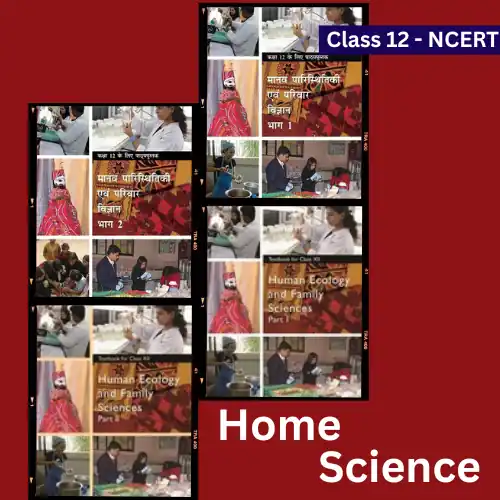
The Class 12 Home Science curriculum under CBSE is officially titled Human Ecology & Family Sciences, but widely referred to as Home Science as a subject. It is published in two parts by NCERT, both available in Hindi and English:
| Home Science TextBooks (Class – 12) English Title | Home Science TextBooks (Class – 12) Hindi Title |
|---|---|
| Human Ecology & Family Sciences – Part I | मानव पारिस्थितिकी एवं पारिवारिक विज्ञान – भाग 1 |
| Human Ecology & Family Sciences – Part II | मानव पारिस्थितिकी एवं पारिवारिक विज्ञान – भाग 2 |
These books cover diverse and practical life domains, from nutrition, food safety, child care, human development, to textiles, communication, and consumer education. They equip learners with essential life skills, scientific reasoning, and social responsibility — preparing them for CBSE board exams, CUET (Home Science), and undergraduate courses in Nutrition, Textile Design, Human Development, Hospitality, and Social Work.
Home Science Textbooks – 12th Class – NCERT
Download Home Science NCERT in English Medium
Download Home Science NCERT in Hindi Medium
| Part / Chapter No. | Home Science Text Book Class – 12 (English) | Home Science Text Book Class – 12 (Hindi) |
|---|---|---|
| Part I – Chapter 1 | Work, Livelihood and Career | कार्य, जीविका और कैरियर |
| Part I – Chapter 2 | Clinical Nutrition and Dietetics | नैदानिक पोषण एवं आहार विज्ञान |
| Part I – Chapter 3 | Public Nutrition and Health | सार्वजनिक पोषण और स्वास्थ्य |
| Part I – Chapter 4 | Food Processing and Technology | खाद्य प्रसंस्करण और प्रौद्योगिकी |
| Part I – Chapter 5 | Food Quality and Food Safety | खाद्य गुणवत्ता और खाद्य सुरक्षा |
| Part I – Chapter 6 | Early Childhood Care and Education | प्रारंभिक बाल्यावस्था देखभाल एवं शिक्षा |
| Part I – Chapter 7 | Management of Support Services, Institutions & Programmes for Children, Youth & Elderly | बच्चों, युवाओं और वृद्धजनों के लिए सहायक सेवाओं, संस्थाओं और कार्यक्रमों का प्रबंधन |
| Part I – Chapter 8 | Career Options after Home Science | गृह विज्ञान के बाद करियर विकल्प |
| ➡️ Part II: Human Ecology & Family Sciences – Part II | Chapters | (शीर्षक) |
| Part II – Chapter 1 | Design for Fabric and Apparel | वस्त्र और परिधान के लिए डिज़ाइन |
| Part II – Chapter 2 | Fashion Design and Merchandising | फैशन डिज़ाइन और विपणन |
| Part II – Chapter 3 | Production & Quality Control in Garment Industry | परिधान उद्योग में उत्पादन और गुणवत्ता नियंत्रण |
| Part II – Chapter 4 | Textile Conservation in Museums | संग्रहालयों में वस्त्र संरक्षण |
| Part II – Chapter 5 | Care & Maintenance of Fabrics in Institutions | संस्थानों में वस्त्रों की देखभाल और रखरखाव |
| Part II – Chapter 6 | Hospitality Management | आतिथ्य प्रबंधन |
| Part II – Chapter 7 | Consumer Education and Protection | उपभोक्ता शिक्षा और संरक्षण |
| Part II – Chapter 8 | Development Communication and Journalism | विकास संचार और पत्रकारिता |
| Part II – Chapter 9 | Corporate Communication & Public Relations | कॉर्पोरेट संचार और जनसंपर्क |
| Part II – Chapter 10 | Management of Development Programmes | विकास कार्यक्रमों का प्रबंधन |
Fine Arts – Class 12th – NCERT Textbook
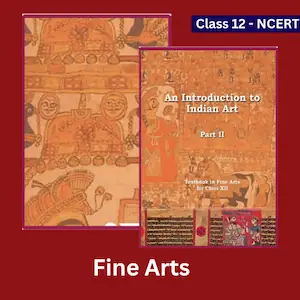
The Class 12 Fine Arts curriculum under CBSE is structured around a single NCERT textbook titled An Introduction to Indian Art – Part II in English and भारतीय कला का परिचय – भाग 2 in Hindi. The subject covers painting, sculpture, graphics, and applied arts, with emphasis on India’s heritage of manuscript painting, miniature styles, modern art, and living traditions.
This book blends aesthetic theory with practical skills to build students’ understanding and appreciation of the visual arts, while preparing them for CBSE board exams, undergraduate Fine Arts entrance tests, and careers in design, architecture, and creative industries.
Fine Arts Textbooks – 12th Class – NCERT
Download An Introduction to Indian Art – Part II
| Class 12 – Fine Arts – An Introduction to Indian Art – Part II | Class 12 – Fine Arts –भारतीय कला का परिचय – भाग 2 |
|---|---|
| 1. The Manuscript Painting Tradition | 1. पांडुलिपि चित्रण परंपरा |
| 2. The Rajasthani Schools of Painting | 2. राजस्थानी चित्रकला शैलियाँ |
| 3. The Mughal School of Miniature Painting | 3. मुगल लघुचित्र कला |
| 4. The Deccan Schools of Painting | 4. दक्कनी चित्रकला शैलियाँ |
| 5. The Pahari Schools of Painting | 5. पहाड़ी चित्रकला शैलियाँ |
| 6. The Bengal School and Cultural Nationalism | 6. बंगाल स्कूल और सांस्कृतिक राष्ट्रवाद |
| 7. Modern Indian Art | 7. आधुनिक भारतीय कला |
| 8. The Living Art Traditions of India | 8. भारत की जीवित कला परंपराएँ |
Music – Class 12th – NCERT Textbook
Class 12 CBSE Music offers two Hindi-medium only NCERT textbooks:
- “संगीत – तबला एवं पखावज” (Sangeet – Tabla evam Pakhawaj, Code 12151)
- “हिंदुस्तानी संगीत – गायन एवं वादन” (Hindustani Sangeet – Gayan evam Vadan, Code 12152)
Both are the latest revised editions (2025–26).
- The first text focuses on percussion—history, gharanas, technical forms (like Kayada, Paran), talas, and proper playing techniques.
- The second is dedicated to vocal music—covering theoretical aspects of raga, tala, notation, performance styles, and composer biographies.
These books are fully aligned with CBSE’s board exam requirements and also prepare students for advanced studies in Indian classical music.
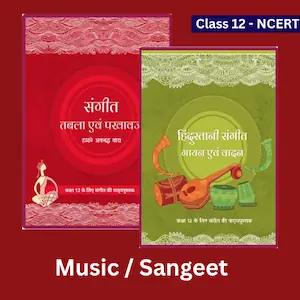
Music / Sangeet Textbooks – 12th Class – NCERT
संगीत – तबला एवं पखावज
हिंदुस्तानी संगीत – गायन एवं वादन
| Sangeet – Tabla evam Pakhawaj / संगीत – तबला एवं पखावज | Hindustani Sangeet – Gayan evam Vadan / हिंदुस्तानी संगीत – गायन एवं वादन |
|---|---|
| 1. भारतीय संगीत का सामान्य परिचय | 1. हिंदुस्तानी संगीत का इतिहास और मूलभूत परिभाषाएँ |
| 2. तबला एवं पखावज वाद्यों का परिचय | 2. रागों की थ्योरी और समय सिद्धांत |
| 3. तबला एवं पखावज वाद्यों के बोल और वर्ण | 3. बंदिशों के प्रकार (विलंबित, द्रुत खयाल, तराना, धमार) |
| 4. तबला एवं पखावज वाद्यों की उत्पत्ति व विकास | 4. ताल संरचना, तालों की लिपि, रचनाएँ |
| 5. ताल–लिपि पद्धति और ठेक | 5. वादन के अंग, संगति, और स्वर-स्थापन |
| 6. पारिभाषिक शब्दावली | 6. संगीतज्ञों का जीवन परिचय एवं योगदान |
| 7. भारतीय संगीत में वाद्य वर्गीकरण | 7. अभ्यास तकनीक और प्रस्तुति कौशल |
| 8. तबला एवं पखावज घरानों का वर्णन | 8. संगीत प्रशिक्षण और प्रदर्शन से जुड़े अभ्यास |
Download Class-12 Other NCERT Books


Class 12 NCERT Books PDF Download – Direct Links
Get the latest Class 12 NCERT complete textbooks in PDF format for free.
Download subject-wise books in English and Hindi, as per the 2025–26 syllabus — directly from the official NCERT sources. Download Class 12 NCERT Books for All Subjects
- ✅ Direct download links from official NCERT portal
- ✅ No login or registration needed
- ✅ Updated for academic year 2025–26
- ✅ Organized by subject & medium (English / Hindi)
NCERT Textbooks are Must for Class 12th CBSE Board Exams
NCERT textbooks are universally applicable for all Class 12 students studying under the CBSE (Central Board of Secondary Education).
These books are followed by every CBSE-affiliated school across India and abroad, making them a common academic foundation for lakhs of students.
Prepared by subject experts and based on robust child pedagogy, NCERT textbooks are designed to enhance conceptual understanding and align with real-life learning outcomes. They ensure gradual progression of topics, clarity in explanations, and encourage critical thinking.
Here’s why NCERT textbooks are indispensable for Class 12 students (click here):
- ✅ They are the only books strictly based on the latest CBSE syllabus and exam pattern.Every question in CBSE board exams is either directly from or derived from NCERT content.
- ✅ Trusted by toppers, recommended by teachers, and aligned with NEP 2020 (National Education Policy).The updated textbooks follow the new education reforms and aim to build foundational clarity.
- ✅ Also useful for national-level entrance exams like NEET (National Eligibility cum Entrance Test), JEE (Joint Entrance Examination), CUET (Common University Entrance Test), and NDA (National Defence Academy exam).
- These competitive exams rely heavily on NCERT-based questions, especially for subjects like Physics, Chemistry, and Biology.
FAQs – Class 12 NCERT Books & CBSE Board
Q1. Why should a student read NCERT Textbooks?
Q2. Is CBSE Board only in India?
This offers Indian expatriates and international students access to high-quality, standardized education based on the Indian curriculum. The board follows a consistent academic structure, making it easy for students to transition between schools, whether in India or abroad.
CBSE-affiliated schools are present in more than 25 countries, including:
United Arab Emirates (UAE), Saudi Arabia, Singapore, Oman, Qatar, Nepal, Kuwait, Bahrain, and Malaysia.
Students in these countries can enroll in CBSE curriculum schools and appear for board examinations just like Indian students. The CBSE international presence helps ensure educational continuity for Indian families residing overseas and also makes it easier for students planning higher education or relocation to India.
Q3. What is the relevance of NCERT Textbooks for 12th Class Board Exams?
Q4. What are the subject streams in Class 12th?
Q5. Under which education policy are NCERT books made?
Q6. In how many mediums are NCERT Textbooks available?
NCERT textbooks are officially published in two mediums: English and Hindi. Select titles are also being translated into regional languages as part of inclusive education efforts. This allows students across linguistic backgrounds to access standardized learning material effectively.